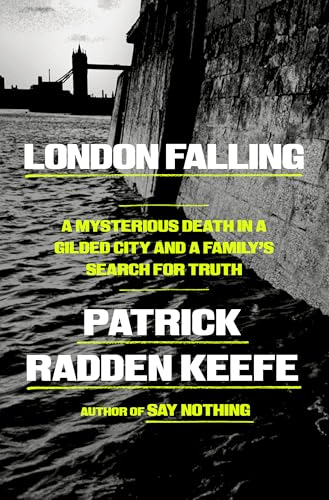
In the early morning of November 29th, 2019, surveillance cameras at the headquarters of MI6, Britian’s spy agency, captured video of a young man pacing back and forth on a high balcony of Riverwalk, a luxury tower on the bank of the river Thames and then jumping into the river. In a quiet London neighborhood several miles away, Rachelle Brettler was worried about her son. Zac had told her that he had gone to stay with a friend but then he did not come home. Days later, a police car pulled up, and two officers relayed the dreadful news: her son was dead. Rachelle and her husband, Mathew, struggled to understand what had happened to Zac. He had his troubles, but in no way seemed suicidal. Only after his death did they learn that he had adopted a fictitious alter-ego: Zac Ismailov, son of a Russian oligarch and heir to a great fortune. Under this guise, Zac had become entangled with a slippery London businessman named Akbar Shamji and a gangster known as “Indian Dave”.
First of all, I hate to say this but if you’re going to write a book about the death of a person, make sure the person is sympathetic enough for me to care about their life and death. It was really hard for me to sit through a book where the author tries to convince me that Zac is a victim. Zac was gallivanting around London pretending to be the heir of a Russian billionaire to the extent where he changed his surname and his accent. I tried really hard to feel sorry for his parents, but I think their guilt is why they’re pursuing this as some great injustice. They shared stories about their background which is supposed to make them seem modest compared to the rich Russians, but their kids went to some of the most expensive secondary schools in London, they lived in a very affluent part of the city and they had a second home in New York City. In fact, the father was a banker while the mother wrote a superfluous column called “how to spend your money” where she gives advice on which luxury goods to buy. Zac was a bad person who was eager to surround himself with bad people and had bad people as his role models all of this he proudly verbalized to his parents. I mean this is a boy who strangled his mother because she was arguing with him which they just glossed over like it was not a symptom of a bigger problem. Zac was always going to get himself killed, get someone else killed or kill someone else in his quest for riches. He sought these shady characters out and considering that there’s actual CCTV footage of him killing himself I frankly don’t know what we’re doing here. I also think it’s quite telling that Keefe waited till almost the last chapter to tell us that Zac was definitely selling drugs through an account he had set up on instagram and then never mentioned it again.
I would genuinely like to know why this book was written. It’s like Keefe’s agent convinced him to write it and then he had to be so repetitive in order to get to the word count his agent told him he needed to reach in order to call this a book. Keefe tells us the history of Russian money in London and how London became a way for the wealthy Russians, Indians, Ugandans and Nigerians to hide their wealth by buying insanely expensive real estate and making sure their children are educated in the most expensive British schools. But how does this actually connect to Zac’s death? Zac sought these shady characters out; they didn’t seek him out. I do not think this death was a way to talk about these larger ideas about wealth and class in London. The mystery surrounding Zac’s death is ultimately not at all that complex a web to unravel and is filled with so much conjecture considering that the nature of testimony assembled came from a crew of pathological grifters about a kid with a pathological lying problem. I struggled with a lot of Keefe’s tangents – from Idi amin, to Uganda, to Mohammed Ali, the bizarre detour into mermaid theater and then he went on a literary hit job of Akbar Shamji and his entire family even though there was irrevocable proof that Akbar could not have killed Zac because there was concrete proof he wasn’t even there when Zac jumped. Don’t get me wrong, Akbar is completely abhorrent and shady and the fact that he knew Zac was dead but didn’t tell his parents is definitely shady, so do not think this is an endorsement of him. But while Keefe strived to convince us of Zac’s innocence and him being a victim he does not give other kids and minors any of that consideration. He proceeds to name Akbar’s kids by name and goes on to tell us exactly which schools they are currently enrolled in. He also kept mentioning his wife’s business as if trying to punish Akbar any way he can even if innocent people ended up being collateral. Also, Keefe’s constant wondering of who is or is not gay was quite offensive.
And then we come to Zac’s parents who for some reason, the author tried to paint as middle class but they had enough power to be able to take this story full of holes to the very top trying to get justice for their kids in rooms that none of us would even hope to be in. I do not hold most parents responsible for how their kids turn out. You can do all you can as a parent and your kid could still turn out terrible. I think this is an idea that the author kept pushing on us. He made sure to tell us how decent and naive Zac’s parents were but then contrasts it by telling us about Akbar’s parents and trying to make the connection between Akbar and his father, so which is it? Are parents a direct reflection of their kids or are they not? Zac showed Mathew a bank account balance of eight hundred thousand pounds and he didn’t push him to tell him the exact way he got that money. They tried way too much to placate him and then when they found out he was dead, pivoted to treating him as a victim, a pivot that made no sense to me. Zac’s parents instead of going to the police to find their missing child, first hired a private investigator because they suspected that their son was involved in criminal activity and they didn’t want to ruin his future and does this not show a pattern of parents who never let their son face the consequences of his actions? Even though they knew he could possibly be making money through criminal means they still tried to claim naivety of what he was actually up to in London. Mind you this is a kid who moved to one of the most expensive zip codes in London and straight up told his parents they could not visit him. The author then goes on a strange tangent talking about Zac’s granddad and the lies he kept from his family as if to contrast Zac’s lying pattern to that of the grandparent? Like he couldn’t have gotten it from his parents but possibly his grandfather? Zac’s father starts going to therapy to deal with his death, but this is the same man who refused to do family therapy after Zac tried to strangle his wife because he doesn’t believe in therapy.
I do not like reading nonfiction books where the author has absolutely no objectivity about the subject of the book. Keefe was way too involved with Zac’s family to actually write an objective book. He admitted to spending so much time with the parents. For an author who authored such big topics as the Sackler dynasty and oxytocin, this subject matter just seems really odd. It’s so obvious that Zac did a lot of investigation and when he couldn’t pull it all together to make one coherent point, he still decided to put it all in the book anyway since he already had the information. The timeline and organization jump around so much, to the point it was nearly impossible to follow the relevancy as a hundred different threads are introduced with only about a fourth of them being relevant. By the end of the story, I felt like nothing had reached a resolution and nothing ever did. And then the epilogue notes saying he wanted the story to mirror the confusion the family felt during the investigation was to me such a ridiculous excuse for such disjointed writing. 90% of this book is conjecture – there is so much “if this happened and if that happened then we surmise that this is the truth” and I’m not being hyperbolic, almost every single sentence structure involving the death of Zac is like the above.
All in all, after reading this book, I found myself asking myself “and so?”. I also think this book existing is such a function of being the right race and the right class because I cannot imagine anybody feeling sorry for Zac if he wasn’t white and from the right background. If Keefe wrote this in order to show how London has become a safe haven for Russain Oligarchs then he added nothing new here and the book you should be reading to learn about this is called “From Russia with Blood” by Heidi Blake and besides, none of the people Zac actually got entangled with were actually Russian, Zac was the one obsessed with the concept of Russian oligarchs and pretended to be one of them.
I gave this book 1 star on Goodreads.
Leggy


