“Eight of the ten commandments are about what thou shalt not. But you can live a whole life not doing any of that stuff and still avoid doing any good. That’s the whole crisis. The rot at the root of everything. The belief that goodness is built on a constructed absence, not-doing. That belief corrupts everything, has everyone with any power sitting on their hands.”
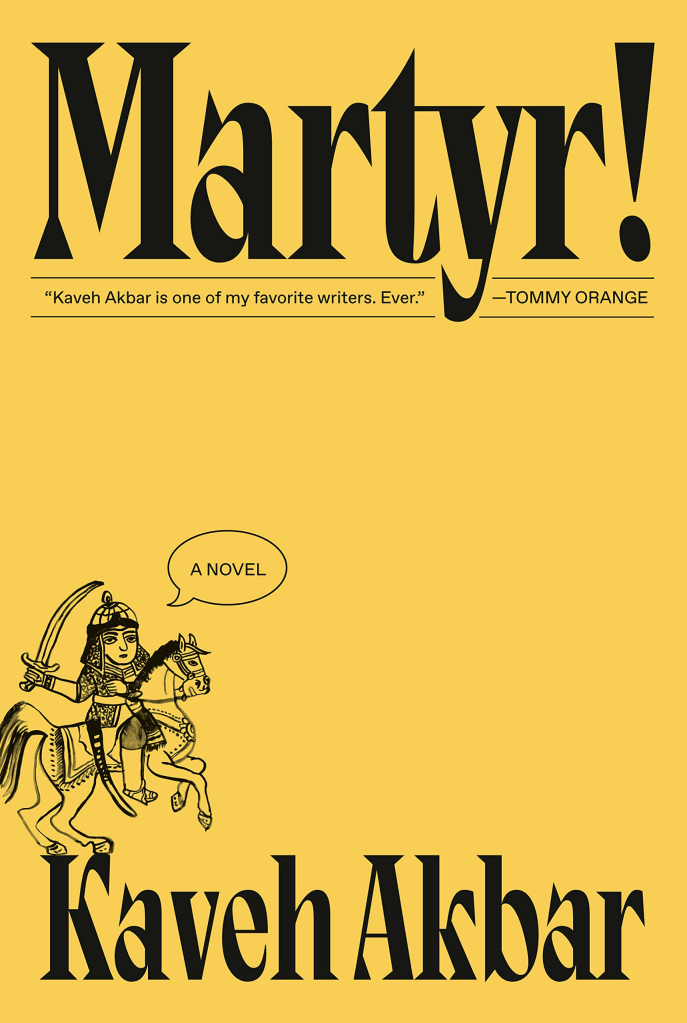
Cyrus Shams is a young man grappling with an inheritance of violence and loss: his mother’s plane was shot down over the skies of Tehran by America in a senseless accident and his father moved them to the same country responsible for his mother’s death. His father’s life in America is that of survival and making sure that Cyrus also survived. But now, after his father dies, Cyrus is truly alone and is struggling with a lot of addiction issues while developing an obsession with martyrs. He decides that he also wants his death to mean something as he stumbles upon an art installation in New York City where a woman who is dying of cancer is lying there every day until her death, talking to anyone who wants to talk.
“There’s this story I read one time, some old-school Muslim fairy tale, maybe it was a discarded hadith I guess, but it was all about the first time Satan sees Adam. Satan circles around him, inspecting him like a used car or something, this new creation—God’s favorite, apparently. Satan’s unimpressed, doesn’t get it. And then Satan steps into Adam’s mouth, disappears completely inside him and passes through all his guts and intestines and finally emerges out his anus. And when he gets out, Satan’s laughing and laughing. Rolling around. He passes all the way through the first man and he’s rolling around laughing, in tears, and he says to God, ‘This is what you’ve made? He’s all empty! All hollow!’ He can’t believe his luck. How easy his job is going to be. Humans are just a long emptiness waiting to be filled.”
It took me a while to actually start this book because every time it would check out to me; I would send it right back. I saw it so much on Instagram and on so many lists. I read the blurb and felt bored but eventually I decided to just give it a go and I absolutely enjoyed it. One of the reasons I was avoiding this one is because I expected it to be depressing. Martyrs? Lord. But once you meet Cyrus and his self-righteous deep thinking, you can’t help but roll your eyes at all his navel gazing. For a book that explores death, depression and sobriety, it never feels depressing. I actually found it funny in so many ways and the wry humor kept me reading even though Cyrus is the embodiment of “youth is wasted on the young”.
“The performance of certainty seemed to be at the root of so much grief. Everyone in America seemed to be afraid and hurting and angry, starving for a fight they could win. And more than that even, they seemed certain their natural state was to be happy, contented, and rich. The genesis of everyone’s pain had to be external, such was their certainty. And so legislators legislated, building border walls, barring citizens of there from entering here. “The pain we feel comes from them, not ourselves,” said the banners, and people cheered, certain of all the certainty. But the next day they’d wake up and find that what had hurt in them still hurt.”
This book is Kaveh Akbar’s debut novel, and everyone knows I grade these on a curve. I’ve never read any of his poetry and I wonder if his writing would have felt familiar if I did. This is an ambitious work that sometimes misses the mark but through Cyrus, we investigate the concept of identity, especially living in a country that caused your mother’s death. And even though you want to lean into your identity as an Iranian, you find out that most of your thoughts and even your addictions are thoroughly American. As he dives into his family’s history – his father’s slow descent into despair and alcoholism, his uncle dressed as the Angel of Death during the Iranian war to convince dying soldiers to die with dignity and not try to desert the army – you begin to understand why Cyrus is so obsessed with death.
“An anthropologist who wrote about how the first artifact of civilization wasn’t a hammer or arrowhead, but a human femur—discovered in Madagascar—that showed signs of having healed from a bad fracture. In the animal world, a broken leg meant you starved, so a healed femur meant that some human had supported another’s long recovery, fed them, cleaned the wound. And thus, the author argued, began civilization. Augured not by an instrument of murder, but by a fracture bound, a bit of food brought back for another.”
Cyrus doesn’t want to be just another depressed boy who kills himself. He wants his death to mean something, and he is convinced that the woman who is dying in a New York art gallery will help him understand how to make his own death mean something. I really loved Cyrus’ discussions with Orkideh. When he tells her of his plans she says: ahh, another Iranian man obsessed with martyrdom.
“Why should the Prophet Muhammad get a whole visit from an archangel? Why should Saul get to see the literal light of heaven on the road to Damascus? Of course it would be easy to establish bedrock faith after such clear-cut revelation. How was it fair to celebrate those guys for faith that wasn’t faith at all, that was just obedience to what they plainly observed to be true? And what sense did it make to punish the rest of humanity who had never been privy to such explicit revelation?”
I didn’t know the author was a poet before starting this book but the amount of quotes I want to share with you shows you how incredibly well this book is written. Did it set out to do too much and at the end succumbed to cliche? Yes. But I liked the journey and even the cliche ending didn’t dim that for me. I gave this book 4 stars on Goodreads.
Leggy

 TwoNightStands